
10mm Carbine: Best Options, Features, Ballistics & What to Know
The 10mm carbine occupies an intriguing position in the world of pistol-caliber carbines (PCCs). It combines the familiar 10mm Auto cartridge with a longer-barreled platform, giving shooters a different balance of velocity, controllability, handling, and portability than a conventional 10mm handgun.
While 9mm dominates the PCC market, the 10mm Auto has attracted attention from shooters who want more performance from a pistol-caliber platform. A longer barrel can increase velocity with many 10mm loads, while a shoulder-stocked carbine can make the cartridge easier to manage than it is in a handgun.
The market is still relatively small, however. Current options include platforms from manufacturers such as CMMG, Ruger, Hi-Point, KRISS, and Smith & Wesson, along with the TNW Aero Survival Rifle. Gun Digest’s comparison similarly notes that the 10mm carbine market has fewer choices than the much larger 9mm PCC segment.
If you’re researching the best PCC chambered in 10mm, the right choice depends on what matters most to you: portability, magazine compatibility, price, folding capability, ergonomics, or overall shooting characteristics.
What Is a 10mm Carbine?
A 10mm carbine rifle is a longer firearm chambered for the 10mm Auto cartridge. Although terminology varies by model and jurisdiction, many 10mm carbines are classified as pistol-caliber carbines because they use a handgun cartridge in a carbine-length platform.
The basic concept is straightforward:
- A handgun cartridge is used in a longer firearm.
- The longer barrel may produce additional velocity with suitable ammunition.
- The carbine’s greater weight and shoulder-stock configuration can make recoil easier to manage.
- Many modern designs accept magazines compatible with 10mm pistols.
- Some models prioritize compact storage through folding or takedown designs.
The 10mm Auto was originally developed as a high-performance autoloading handgun cartridge. Its relatively high operating pressure and broad range of bullet weights have helped it remain popular among shooters looking for a more powerful pistol cartridge.
A carbine doesn’t magically turn 10mm into a traditional rifle cartridge, though. The projectile remains a pistol bullet, and its external ballistics are still different from cartridges designed specifically for rifles.
Why Put 10mm in a Carbine?
The biggest reason is the combination of 10mm performance and carbine handling.
In a handgun, full-power 10mm ammunition can generate substantial recoil. Moving the cartridge into a heavier, shoulder-fired platform changes the shooting experience considerably. The additional mass and three-point contact provided by a stock can make the firearm feel more stable.
The longer barrel can also increase velocity. The exact gain depends heavily on the ammunition, barrel length, and firearm. Independent testing shows that velocity can vary substantially between loads and barrel lengths, so generalized claims about a specific percentage increase should be treated cautiously.
Gun Digest’s testing and discussion of 10mm carbines found that the velocity improvement from a carbine-length barrel can be useful, but it doesn’t transform the cartridge into a true long-range rifle round.
That makes the 10mm carbine particularly interesting for shooters who want:
- More manageable recoil than a 10mm handgun
- A compact alternative to a traditional rifle
- The ability to use a pistol-caliber platform
- Potentially higher velocity from a longer barrel
- A platform suitable for recreational shooting
- A carbine that can share magazines with a compatible handgun
Best 10mm Carbine Options
There isn’t one universal best pistol caliber carbine for every shooter. The following models represent different approaches to the 10mm PCC category.
1. Ruger LC Carbine 10mm

The Ruger LC Carbine 10mm is one of the most feature-rich options in this category.
Ruger introduced its LC Carbine chambered in 10mm Auto in 2024. The platform uses a 16.25-inch threaded barrel, adjustable folding stock, folding sights, ambidextrous controls, and compatibility with Glock-pattern 10mm magazines.
Its folding stock is one of its defining characteristics. With the stock folded, the carbine becomes substantially more compact for storage and transportation.
The platform also incorporates an aluminum-free-float M-LOK handguard, a full-length top Picatinny rail, and additional mounting points.
| Pros | Cons |
|---|---|
| Folding and adjustable stock | Heavier than some compact PCCs |
| 16.25-inch barrel | Blowback action |
| Glock-pattern magazine compatibility | Triggers may not appeal to everyone. |
| M-LOK handguard | Larger than very compact PCC designs when unfolded |
| Threaded barrel | Availability and legality vary by location. |
For someone specifically searching for a 10mm folding carbine, the Ruger deserves particular attention because its folding stock is part of the factory design rather than an aftermarket modification.
2. Smith & Wesson M&P FPC 10mm

The Smith & Wesson 10mm carbine option comes in the form of the M&P FPC.
The FPC is notable because its folding mechanism is central to the design. The 10mm version has a 16.25-inch barrel and folds to approximately 16.4 inches for storage. Smith & Wesson also designed the platform around M&P-pattern magazines, with the standard version supplied with three 15-round magazines.
The carbine also features M-LOK slots, an upper Picatinny rail, an integrated recoil buffer, and a threaded muzzle.
The M&P FPC makes a particularly compelling case for shooters who already use compatible M&P 10mm pistols because of magazine commonality.
| Pros | Cons |
|---|---|
| Folds for compact storage | The magazine system differs from the Glock-pattern PCCs. |
| Lightweight design | Blowback operation |
| 16.25-inch barrel | The folding mechanism adds design complexity. |
| Uses M&P 10mm magazines | Capacity varies by configuration and local requirements. |
| Accessory mounting options | Some controls may take familiarization. |
The FPC also demonstrates how quickly the 10mm PCC category has expanded. Smith & Wesson initially launched the FPC in other configurations before adding 10mm to the lineup.
3. Hi-Point 1095

If price is your biggest consideration, the Hi-Point 10mm carbine, known as the 1095, is one of the more accessible options.
Hi-Point lists the 1095 as a 10mm auto carbine with a 17.5-inch barrel, 32-inch overall length, and a 10-round standard magazine.
The design is deliberately straightforward. It uses a blowback operating system, polymer components, and a fixed configuration. Hi-Point also provides adjustable sights, an accessory rail, and a threaded barrel on applicable carbine configurations.
The trade-off is that it lacks some of the refinement and modularity found on more expensive 10mm PCCs.
| Pros | Cons |
|---|---|
| Generally budget-oriented | Heavier than several competitors |
| Simple blowback design | Proprietary magazine |
| Threaded barrel on applicable model | Standard capacity is 10 rounds. |
| Adjustable sights | Less refined ergonomics |
| Lifetime warranty | Fixed stock configuration |
What About a Hi-Point 10mm Carbine 30-Round Magazine?
This is an important distinction when researching the Hi-Point 10mm carbine 30-round magazine.
The standard Hi-Point 1095 is listed by the manufacturer with a 10-round magazine, and Hi-Point identifies its magazine system as proprietary.
Therefore, buyers shouldn’t assume that a 30-round magazine designed for another 10mm platform will automatically work with the 1095.
This is one area where the Ruger LC Carbine, CMMG Banshee Mk10, and some other Glock-pattern platforms have an advantage in terms of magazine ecosystem.
Always verify magazine compatibility with the specific firearm and follow applicable magazine-capacity laws in your jurisdiction.
4. CMMG Banshee Mk10

The CMMG Banshee Mk10 takes a different approach from the traditional blowback 10mm PCC.
CMMG’s Mk10 is chambered in 10mm and uses the company’s radial delayed-blowback operating system. The design is intended to provide a different recoil and handling experience from conventional direct-blowback PCCs.
Gun Digest’s testing ranked the Banshee Mk10 highly for its shooting characteristics and compact size. Its 8-inch barrel makes it considerably shorter than the 16-inch-plus carbines in this category.
The platform also uses Glock-pattern magazines.
| Pros | Cons |
|---|---|
| Compact platform | Shorter barrel |
| Radial delayed-blowback system | Higher price |
| Glock-pattern magazines | Classification depends on configuration and law. |
| Lightweight relative to some PCCs | Less carbine-like than 16-inch platforms |
| AR-style controls and ergonomics | Ammunition performance varies by load |
CMMG also provides technical information concerning ammunition and case expansion for the Mk10. It emphasizes that ammunition characteristics can affect observed case swelling and recommends discontinuing ammunition that exhibits multiple signs of overpressure.
That is a useful reminder that ammunition selection should always follow the firearm manufacturer’s instructions.
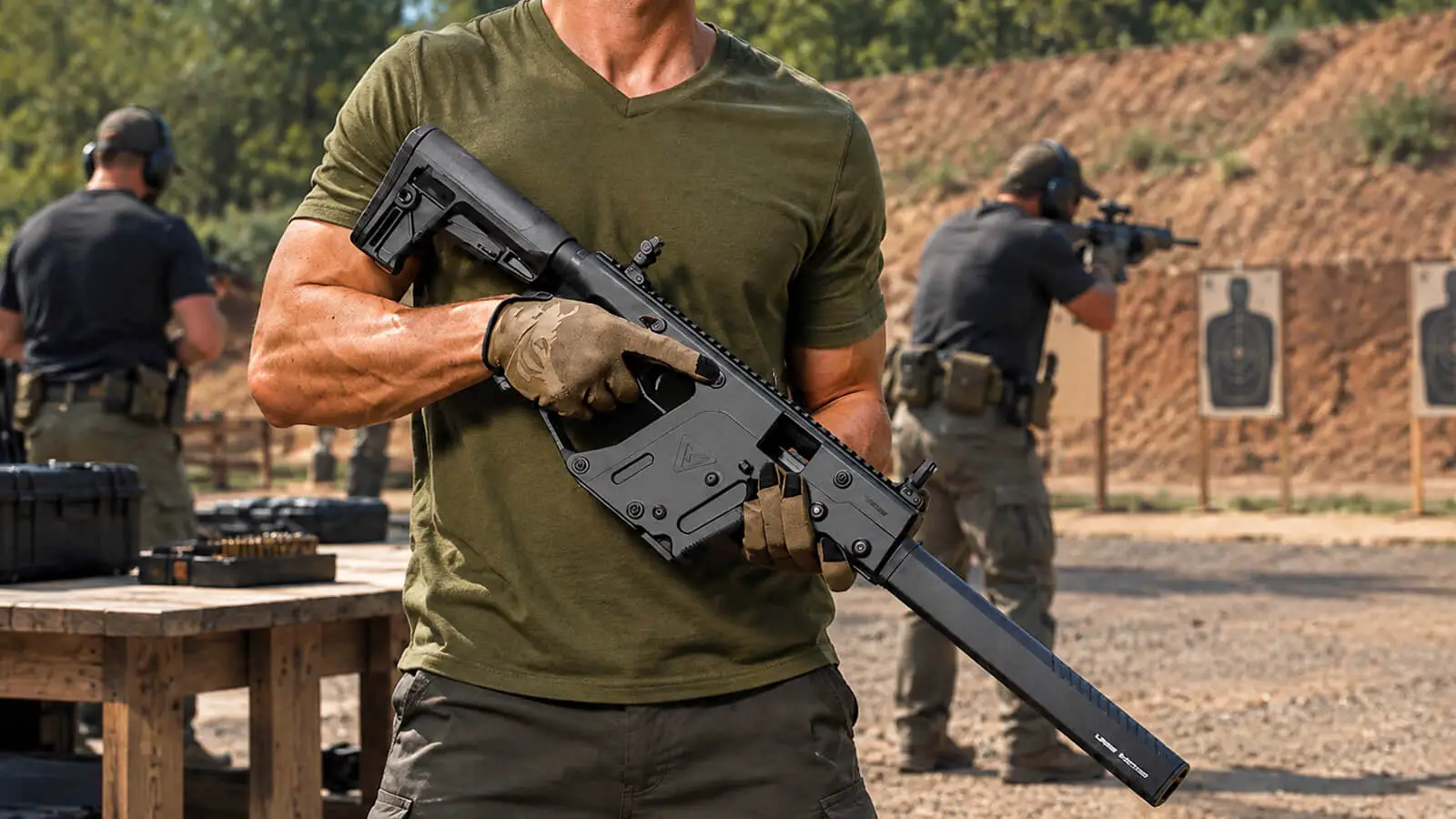
5. KRISS Vector CRB 10mm

The KRISS Vector CRB 10mm carbine is perhaps the most distinctive-looking option in this group.
The Vector uses KRISS’s Super V recoil mitigation system and a delayed-blowback operating system. The system is designed around non-linear bolt travel and recoil management. KRISS documentation lists the CRB in 10mm and specifies a 16-inch barrel for the platform.
The design is heavier and more substantial than some competing PCCs, but that additional mass can contribute to a different shooting feel.
Gun Digest placed the Vector CRB among its high-end 10mm carbine choices, noting its ergonomics, Glock-magazine compatibility, and distinctive recoil system.
| Pros | Cons |
|---|---|
| Distinctive design | Relatively heavy |
| Recoil mitigation system | Expensive |
| Glock-compatible magazines | Bulky compared with compact PCCs |
| 16-inch barrel | Configuration-specific features matter. |
| Ergonomic controls | Not the simplest design |
The KRISS Vector CRB 10mm carbine 16—referring to the 16-inch-barreled CRB—provides a very different experience from simpler blowback carbines for those specifically searching for it.
6. TNW Aero Survival Rifle

The TNW Aero Survival Rifle is another interesting entry into the 10mm carbine category.
Its defining feature is portability. The platform is designed as a takedown firearm and can be broken down for easier transportation. A 16.25-inch barrel. It has a 5.5-pound weight and is compatible with Glock-pattern magazines for the 10mm configuration.
Another notable feature is caliber flexibility. The platform has been designed around interchangeable barrel/caliber configurations, giving it a broader role than a dedicated 10mm PCC.
| Pros | Cons |
|---|---|
| Takedown design | Handling differs from conventional PCCs. |
| Lightweight | Less refined shooting feel than premium options |
| Glock magazine compatibility | Feature priorities are focused on portability. |
| Caliber flexibility | Availability may vary. |
| 16.25-inch barrel | Check the current configuration before purchase. |
For people who prioritize packability and versatility, the Aero Survival Rifle is worth including in a comparison of 10mm carbines.
10mm Carbine Comparison
| Model | Barrel | Magazine | Best Suited For |
|---|---|---|---|
| Ruger LC Carbine | 16.25″ | Glock-pattern | General-purpose use |
| S&W M&P FPC | 16.25″ | M&P 10mm | Compact storage |
| Hi-Point 1095 | 17.5″ | Proprietary | Cost-conscious buyers |
| Caliber flexibility | 8″ | Glock-pattern | Compact PCC setup |
| KRISS Vector CRB | 16″ | Glock-pattern | Premium PCC experience |
| TNW Aero | 16.25″ | Glock-pattern | Portability |
Specifications can vary by model, configuration, generation, and jurisdiction, so manufacturer documentation should be treated as the final authority before making a purchase or using a firearm.
Understanding 10mm Carbine Ballistics
10mm carbine ballistics are one of the biggest reasons the platform has gained attention. The 10mm Auto already has a reputation as a relatively powerful pistol cartridge. A longer barrel can allow some ammunition to produce additional velocity, although the increase is not identical across all loads.
For example, independent testing by Ballistics by the Inch recorded significant differences in velocity among various 10mm loads as barrel length changed. The results demonstrate why it is better to discuss 10mm ballistics in terms of specific ammunition and barrel length rather than quoting one universal number.

Several factors affect performance:
1. Barrel length
A longer barrel can provide additional opportunity for the propellant gases to accelerate the bullet. However, velocity does not increase indefinitely as barrel length increases.
2. Bullet weight
10mm ammunition is available with a range of bullet weights. Lighter bullets can often produce higher velocities, while heavier bullets may emphasize momentum and penetration characteristics.
3. Ammunition design
Factory loads vary considerably. A target load, defensive load, and hunting load can have very different characteristics even when they use bullets of similar weight.
4. Firearm design
The action, barrel, and chamber dimensions can influence how a particular load performs.
5. Temperature and environmental conditions
Velocity and trajectory can also be affected by environmental conditions, although these factors are generally less important at typical PCC distances than ammunition and barrel differences.
For this reason, published 10mm carbine ballistics should be treated as reference information rather than a guaranteed performance figure for every firearm.
What Is the Effective Range of a 10mm Carbine?
The answer depends on what you mean by “effective.”
A 10mm carbine can be capable of useful accuracy beyond typical handgun distances, and a carbine’s stock, sighting system, and longer barrel can make precise shooting easier.
However, the 10mm remains a pistol cartridge.
Gun Digest specifically cautions that the longer barrel does not turn the 10mm into a true medium- or long-range cartridge.
For practical purposes, many shooters regard roughly 50–100 yards as a useful general range for many 10mm carbine applications, but there is no universal effective-range number.
A better way to think about it is that the effective range of a 10mm carbine is determined by the firearm, ammunition, sights or optic, shooter skill, environmental conditions, and intended target.
For hunting, ethical range should be based on demonstrated accuracy and sufficient terminal performance—not simply the maximum distance at which a bullet can physically travel.
10mm Carbine for Deer Hunting: Is It Suitable?
A 10mm carbine for deer hunting can make sense in the right circumstances, but legality and ammunition selection are critical.
The cartridge offers more capability than many traditional handgun cartridges, and a carbine can make it easier to shoot accurately than a handgun. Some 10mm loads are also specifically designed for hunting applications.
However, hunters should check their state’s regulations before considering a 10mm carbine for deer. Hunting laws can specify:
- Legal firearm types
- Minimum caliber requirements
- Magazine restrictions
- Barrel requirements
- Permitted hunting seasons
- Ammunition requirements
- Legal hunting areas
Even where a 10mm carbine is legal, it should be viewed as a relatively short-range hunting option rather than a replacement for a conventional deer rifle.
The most important considerations are reliable accuracy, appropriate hunting ammunition, adequate penetration, and responsible shot placement.
10mm Carbine vs. 9mm PCC

Why choose a 10 mm when 9 mm PCCs are so common?
The answer is primarily performance.
| Factor | penetration, PCC | 10mm Carbine |
|---|---|---|
| Ammunition cost | Generally lower | Generally higher |
| Recoil | Usually mild | More substantial |
| Energy potential | Lower | Higher |
| PCC availability | Excellent | Limited |
| Magazine options | Very broad | Growing but smaller |
| Hunting potential | Limited depending on jurisdiction | More suitable for certain hunting applications |
| General range use | Excellent | Excellent |
The 9mm PCC remains the more economical choice for high-volume recreational shooting. The 10mm becomes more attractive when additional power is a priority.
Gun Digest notes that 10mm ammunition generally costs more than comparable 9mm ammunition, which can become significant for shooters who practice frequently.
Is a 10mm Carbine Better Than a 10mm Pistol?
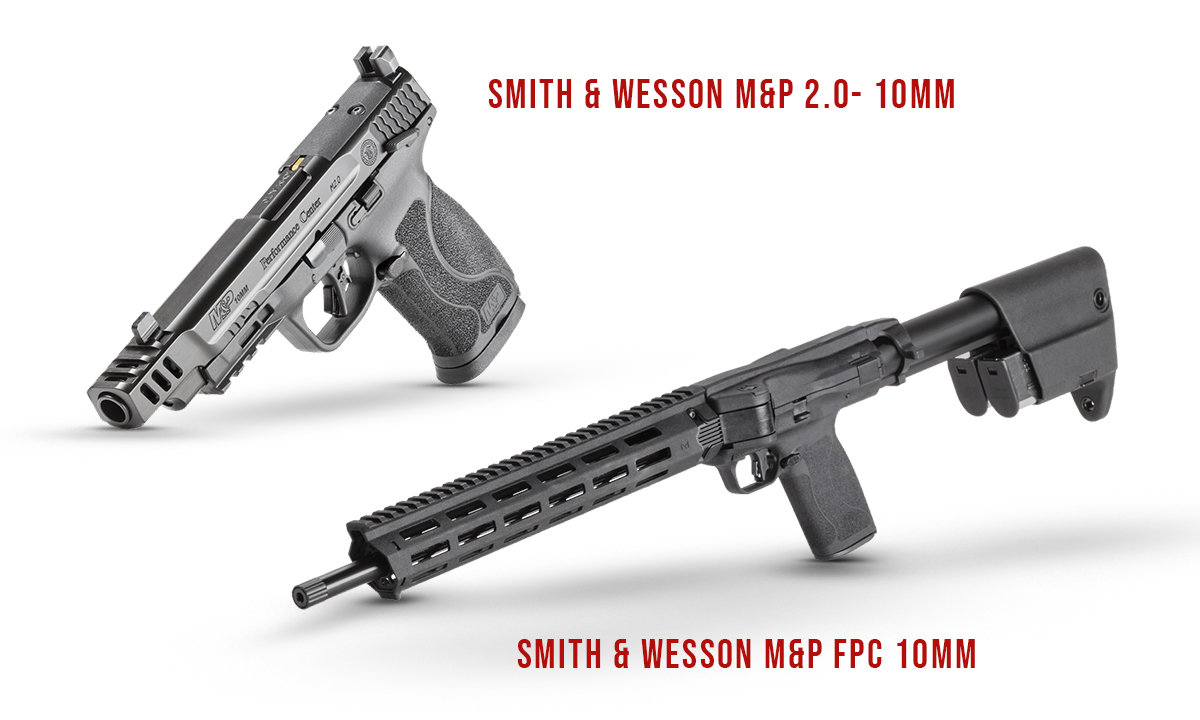
Not necessarily. They serve different purposes. A 10mm pistol is smaller and easier to carry. A 10mm carbine generally provides a longer sighting platform, additional weight, and potentially higher velocity.
The carbine can therefore be easier to control and shoot accurately, particularly for shooters who find full-power 10mm handgun recoil challenging. The pistol, on the other hand, wins on portability.
Think of it this way:
10mm pistol: maximum portability.
10mm carbine: greater stability and potentially more velocity.
Neither automatically replaces the other.
What Should You Look for in a 10mm Carbine?
If you’re comparing the best pistol-caliber carbine options, look beyond the caliber itself.
Magazine compatibility
Magazine availability can have a major impact on convenience and cost. Glock-pattern compatibility is common among several 10mm PCCs, while models such as the Hi-Point 1095 use a proprietary magazine system.
Barrel length
Longer barrels can provide velocity benefits with appropriate ammunition, but they also increase overall size.
Folding or takedown capability
A 10mm folding carbine can be attractive if storage and transportation are priorities. The Ruger LC Carbine and S&W M&P FPC take different approaches to making a 10mm platform more compact.
Weight
Weight can be both an advantage and a disadvantage.
A heavier firearm may help reduce perceived recoil, but it can become tiring to carry over extended periods.
Recoil system
Different manufacturers use different operating systems. CMMG’s radial delayed blowback and KRISS’s Super V system are examples of designs that differ from traditional direct blowback systems.
Ergonomics
Controls, stock adjustment, grip shape, charging handle location, and sighting options can make a noticeable difference in how comfortable a carbine feels.
Intended use
A carbine intended primarily for range use doesn’t necessarily need the same features as one intended for hunting or outdoor use.
Pros and Cons
Pros
- More manageable than many 10mm pistols
- Potential velocity increase from longer barrels
- Greater stability for aiming
- Useful balance between handgun and rifle platforms
- Several modern folding and compact designs
- Some models share magazines with 10mm pistols
- Suitable for recreational shooting
- Can be useful for certain hunting applications where legal
Cons
- Fewer choices than 9mm PCCs
- Ammunition generally costs more than 9mm
- 10 mm recoil remains greater than 9 mm
- Some models are relatively heavy
- Magazine compatibility varies considerably
- Not a substitute for a true rifle cartridge at longer distances
- Hunting legality varies by jurisdiction
Who Makes 10mm Carbines?
Several manufacturers have offered or currently offer 10mm carbine or PCC platforms.
Notable manufacturers include
- Ruger—LC Carbine 10mm
- Smith & Wesson — M&P FPC 10mm
- Hi-Point—1095 10 mm
- CMMG — Banshee Mk10
- KRISS USA — Vector CRB 10mm
- TNW Firearms—Aero Survival Rifle 10mm configuration
The market changes over time, so you should confirm a particular model’s current production status, configuration, and availability directly with its manufacturer.
FAQs
Who makes the 10mm carbine?
Several companies manufacture or have offered 10mm carbines, including Ruger, Smith & Wesson, Hi-Point, CMMG, and KRISS. TNW Firearms has also offered the Aero Survival Rifle in a 10mm configuration. The exact models and availability can change, so checking current manufacturer information is recommended.
What is the effective range of a 10mm carbine?
There is no single universal effective range. For many practical applications, 50–100 yards is a reasonable general reference range, but actual performance depends on ammunition, barrel length, optics or sights, firearm configuration, and shooter ability. A 10mm carbine should not be treated as a long-range rifle simply because it has a longer barrel.
Is a 10mm carbine good for deer hunting?
A 10mm carbine can be appropriate for deer hunting where local regulations allow it and where the hunter uses suitable ammunition and can reliably place shots within the cartridge’s practical range. Always check the applicable hunting regulations before using one for deer.
Does a longer barrel make a 10mm faster?
Often, yes, but not by a fixed amount. The velocity increase depends on the ammunition’s powder characteristics, bullet weight, barrel length, and firearm. Independent testing demonstrates that different 10mm loads can respond differently to increased barrel length.
Is 10mm better than 9mm for a PCC?
“Better” depends on the intended use. 10mm generally offers greater performance potential, while 9mm is usually less expensive, produces less recoil, and has a much larger PCC market. For high-volume range shooting, 9mm may be more economical. If someone is specifically looking for the extra performance of 10mm, a 10mm PCC may be the better fit.
Is the Ruger LC Carbine available in 10mm?
Yes. Ruger introduced the LC Carbine in 10mm Auto in 2024. The model has a 16.25-inch barrel, folding adjustable stock, threaded barrel, and compatibility with Glock-pattern 10mm magazines.
Does the Hi-Point 1095 come with a 30-round magazine?
The standard Hi-Point 1095 is listed by Hi-Point with a 10-round magazine and a proprietary magazine system. Therefore, the commonly searched phrase “Hi-Point 10mm carbine 30-round magazine” should not be interpreted as meaning the standard 1095 ships with a 30-round magazine.
Is the S&W 10mm carbine folding?
Yes. The Smith & Wesson M&P FPC in 10mm uses a folding design that allows it to become substantially shorter for storage and transportation. The 10mm version has a 16.25-inch barrel and uses M&P 10mm magazines.
